



Link: Site for teaching and learning bike riding, and breaching training wheels programming
Better Business Bureau Reliability Seal
Science of Bicycle Balancing

Why Pedal Magic Is So Fast, Safe and Easy
 
You don't have to be an engineer to drive a car! The four scientific principles in Pedal Magic that enable you to teach bike riding so quickly, easily and safely are centripetal force, operant conditioning, game theory and geometric distribution. But you'll never know you are using them.
That bicycle balancing is a simple no-two-ways-about-it matter will be obvious to anyone who knows a little physics (see explanation further below). Even if you do not know physics or what centripetal force is, you will be able to get a general feel for how bike balancing works.

What is not obvious is how it is possible to teach anyone to execute the simple physics in just minutes. This is where the other three principles mentioned above come in. They are imbedded in two tight and precise Pedal Magic drills which virtually all beginners master in 2 to 5 minutes.

The physical forces of bicycle balancing guarantee that a beginner with quick enough reflex and sufficient muscle strength (click for our quick indoor test) will be able to ride a bike. Pedal Magic arms you with the ability to teach any such person to ride easily and safely in minutes.

This page will also help you understand why Pedal Magic is not a pseudo-system of hope-it-works drills. It is a lightning-fast, precise, uncommon-sense technique made easy for ordinary people through the power of science. You just drive the car. The engineering is already done.

...It appears that none of them considered the actual physics of bicycle balancing and how to teach beginners to execute that physics. They merely focused on keeping the learner upright while leaving actual learning up to the nervous and clueless beginner...

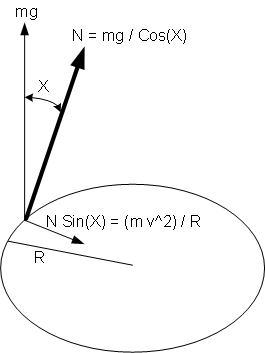
Though Pedal Magic's roots are in solid science and not some seat-of-the-pants notions from the school of hard knocks, the reader need not understand the diagram below or the box next to it to get a general feel for how and why Pedal Magic is able to do what it does.

If you would like to read on do not be intimidated by the diagram and the math. They are not all that hard to understand. The thick arrow in the diagram is a rider starting to lose balance.

What causes a bike to stay up

A beginner is able to keep a bicycle upright starting from the very moment s/he overcomes the instinctive fear-driven human tendency to turn away from the fall. This is exactly the opposite of what physical laws of bicycle balancing dictate.

If it were not for this wrong but powerful inborn wiring of the human brain, riding a bicycle would simply be a matter of getting on one and pedaling.

Therefore, regardless of the method used, teaching and learning bicycle balancing boil down to changing inborn balancing behavior to fearlessly leverage certain physical forces of nature to stay in balance.

You decide how long you want to labor in the teaching mode, and keep your beginner laboring in the learning mode, by the teaching option you choose.

Differences in teaching devices and approaches

Ever since the invention of the bicycle, people have developed numerous devices and methods to teach bike riding.

It appears that none of them considered the actual physics of bicycle balancing and how to teach beginners to execute that physics. They merely focused on keeping the learner upright while leaving actual learning up to the nervous and clueless beginner.

In 1984 a Management Scientist broke through such linear and obvious thinking to create a revolutionary process. It turned the unnecessarily painful and prolonged change process into a quick, focused, safe, 5-minute event full of fun and joy for all concerned.

The physics of bicycle balancing dictates that if one has fast enough reflex, and sufficient muscle strength to pedal a bike, s/ he will be able to ride a bike.

Teaching bike riding is about getting the learner to execute bike balancing physics, not to keep the learner upright somehow. No matter what, the crutches have to come off sometime.

Pedal Magic bypasses all unnecessary activities and goes straight to the heart of bike balancing using a subtle scientific approach. That is why it can have every beginner riding in minutes.

Reverse thinking - the science neither teacher nor student needs to know!

The dominant force involved in bicycle balancing is centripetal force. High school physics text books usually cover circular motion and centripetal force as shown in the diagram below. But, the key to understanding bicycle balancing is a little reverse thinking, which is what triggered the development of the Pedal Magic process.

See The crux of Pedal Magic below the box if you are interested in the rest of the story.

Physics books discuss centripetal force in terms of the required amount of force towards the center of a circle to keep an object from veering off its circular path.

Applying this principle to bike riding, physics books would say that a bicyclist has to tilt the bike X degrees off the vertical towards the center of the circle to create sufficient centripetal force to remain on the circle. This is usually discussed within the context of a bicyclist negotiating a curve on a path.

Value of X (how much to tilt or lean) is calculable from equation inside the circle (m is mass of bike and rider, g is acceleration due to gravity, v is the velocity of the bike, and R is radius of the circle).

If X is too large (i.e. rider tilts too much into the circle), centripetal force will be too much and the bike will start turning into a circle with radius smaller than R. If X is not large enough, there won't be sufficient force to keep the bike on the circle and the bike will veer off, turning in a circle with radius larger than R.
Now for the reverse thinking required to understand what keeps a bicycle in balance...

What we are interested in is not what the value of X should be to keep a bike on the circle, but what we should do to reduce the value of X (i.e. reduce the tilt to bring the bicycle into upright position).

Balance equation in the circle tells us that to reduce X, the rider needs to create an opposite force larger than the existing value of the right hand side of the equation. This can be done by increasing v (velocity) in the numerator, reducing R (radius) in the denominator, or doing both.

The crux of Pedal Magic

Immediate and assured learning without any running or falling arises from the behavioral aspects of bike balancing and a mix of precise scientific principles imbedded in the teaching process, not just this physics component of the method. However, in creating Pedal Magic the first principle Reginald Joules started with was the physics below that keeps a bicycle in balance.

Joules was the first one to develop the reverse-thinking explanation of what keeps a bicycle in balance. Many others had tried to explain bicycle balancing in terms of gyroscopic forces, shifting center of gravity, angular momentum of the wheels, etc. Such references and their weaknesses can easily be found on the Web.

Joules formulated his simple but powerful explanation of bicycle balancing in July 1984 while working out an easy way to teach his daughters to ride. He ended up teaching his wife to ride as well, all in a span of about 15 minutes. The method he built around the above model using additional scientific principles eventually came to be known as Pedal Magic.

Pull and counter-pull

Joules reasoned that when a bike is falling out of balance, it is as if it is making a circle to the side of the fall, pulling the bike towards the center of that circle. He called it the "circle of fall." In order to keep from falling into the circle of fall (i.e. crashing), the rider has to create a counter-pull out of the fall.

There are two ways a rider can create this counter-pull to overcome the fall (if you are not afraid of a little math, look at equation inside the circle above). One choice is to quickly speed up the bicycle. The other is to quickly tighten (shorten) the radius of the circle of fall. Experienced riders instinctively do both as required.

Increasing speed quickly requires a lot of muscle strength and is an undesirable and risky choice for a beginner. Tightening the circle quickly is a much safer and easier choice, especially for children.

Pedal Magic video demonstrates how to physically condition a beginner's brain and body with ease in 2-5 minutes to execute the correct balancing moves. It also contains Pedal Magic's remedial method for beginners with severe training wheels bad habits and dependencies.


Download Pedal Magic Video Now

Click a link below. You will need Windows Media Player Version 9 or higher.

$21.95 payment must be made from a PC to unlock the video on that PC

Pedal Magic License is strictly for personal and immediate family use